1. Retrospective: The 2019 Thesis and the “Laggard” Bottleneck
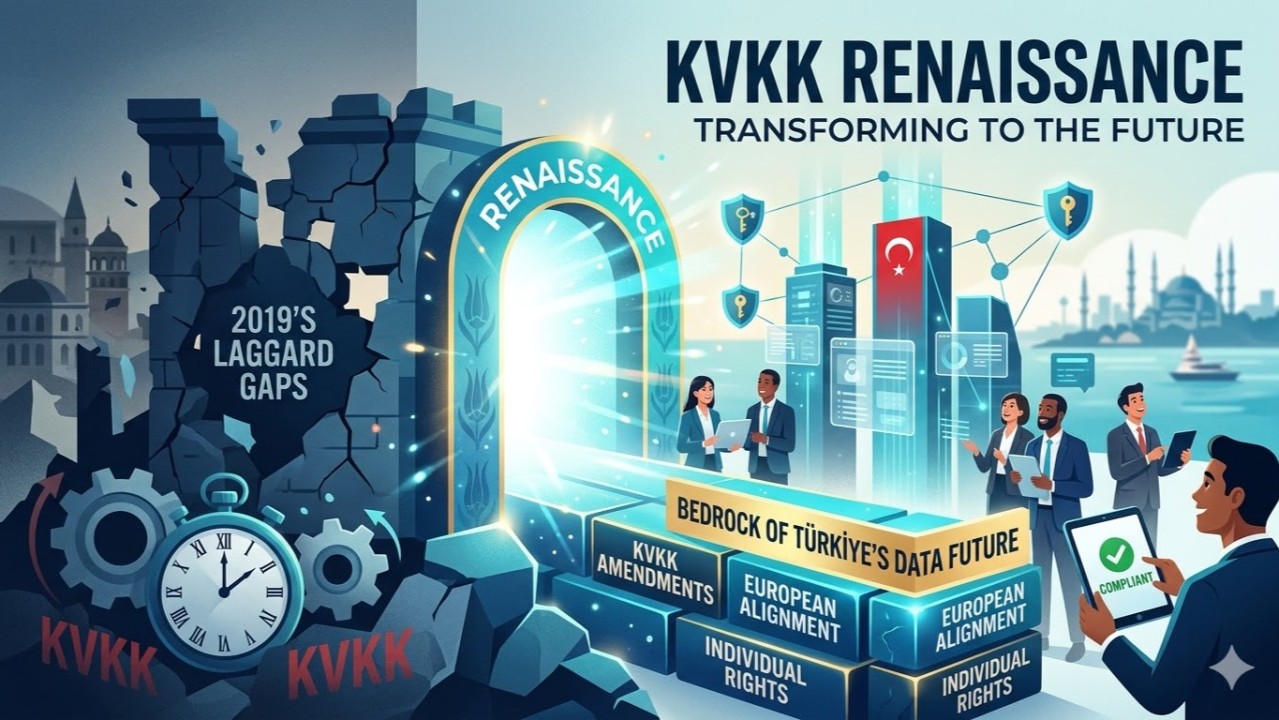
In December 2019, I completed my graduation project titled “Laggard Practices of GDPR, Turkey Case.” At that time, the consensus among practitioners was one of cautious frustration. While Turkey had taken a monumental step with the enactment of Law No. 6698 (KVKK) in 2016, my analysis highlighted a widening gap between Turkish practice and the global gold standard of the GDPR.
My 2019 findings identified three primary “laggard” symptoms:
- The Consent Trap: Unlike the GDPR’s flexible “legitimate interest” or “performance of contract” grounds, Turkey was stuck in an “explicit-consent-centric” model, particularly for international transfers.
- The Sensitive Data Paradox: The rigid distinction between health/sexual life data and other sensitive data made essential business functions—like HR management and social security compliance—legally precarious.
- A “Closed” Ecosystem: Without mechanisms like Standard Contractual Clauses (SCCs), Turkish firms were effectively isolated from global cloud infrastructures, hindering their ability to scale.
2. 2024: The Watershed Year for Harmonization
The “laggard” practices I documented five years ago were finally addressed on June 1, 2024, through the 8th Judicial Package. This reform didn’t just tweak the law; it performed a fundamental “organ transplant” on Articles 6 and 9 of the KVKK to match the GDPR.
The End of Isolation (Article 9 Reform): The reform introduced a three-tier transfer regime that mirrors the EU’s:
- Adequacy Decisions: The Board can now designate “safe” countries or sectors.
- Appropriate Safeguards (The SCC Era): Since late 2024, businesses can finally use Standard Contractual Clauses. This allows for the predictable, automated flow of data to global partners, provided the KVKK is notified within 5 business days.
- Occasional Exceptions: A fallback for one-time, non-repetitive transfers.
The Harmonization of Sensitive Data (Article 6 Reform): The 2024 updates removed the legal bottleneck for processing sensitive data. It can now be processed without explicit consent when mandatory for employment, social security, and social services—a direct solution to the HR paradox I identified in my 2019 research.
3. The AI Pivot: Why Compliance is the New Competitive Advantage
As we look at the landscape in 2025 and 2026, the focus has shifted from simple data storage to AI deployment. Turkey’s updated legal framework is the secret engine behind this shift.
AI Training & The “Laggard” Lesson: If we had remained in the 2019 “consent-centric” model, training Large Language Models (LLMs) on Turkish data would have been legally impossible at scale. Today, the new legal grounds for processing mean that Turkish AI developers can:
- Use global high-performance computing (HPC) via compliant SCCs.
- Process datasets for “legitimate interests” and “explicitly stipulated in law” without being paralyzed by individual consent withdrawals.
The 2026 Frontiers: Platform Liability and Ethical AI In early 2026, we are seeing the next phase of this evolution. New legislative proposals are introducing turnover-based fines (up to 5%) for digital platforms that allow the unauthorized dissemination of AI-generated content (deepfakes). Furthermore, the establishment of the National Technology and Artificial Intelligence General Directorate in December 2025 signals that AI governance is now a central pillar of Turkish state policy.
4. Strategic Roadmap: Future-Proofing for 2026
The journey from the “laggard” era of 2019 to the AI-driven era of today requires a shift in executive strategy:
- From Consent to Accountability: Stop relying solely on tick-boxes. Use the new Standard Contractual Clauses and notify the Authority via the new online modules.
- AI Impact Assessments (DPIA): While not yet a strict KVKK mandate, performing a DPIA is now the de facto requirement for high-risk AI applications in banking, health, and insurance.
- Audit the “AI Lifecycle”: Compliance must exist at every stage—from the training data (Input) to the prompt engineering (Interaction) and the final result (Output).
Conclusion: Trust as the Foundational Asset
The gaps I analyzed in 2019 were more than just legal hurdles; they were barriers to trust. By closing those gaps in 2024 and 2025, Turkey has not just “aligned with the EU”—it has built a launchpad for the next generation of digital innovation.
In 2026, the businesses that will win are those that treat data protection not as a “laggard” obligation, but as the foundational asset of their AI strategy. The laws have caught up; now it is time for our business leaders to lead.
Burak Akusta
Global IT International Executive Vice President